Step Into the Bata Shoe Museum

Navigation

  • Main Website
  • Exhibitions
  • Curatorial
  • Collections
  • Conservation
  • Interviews
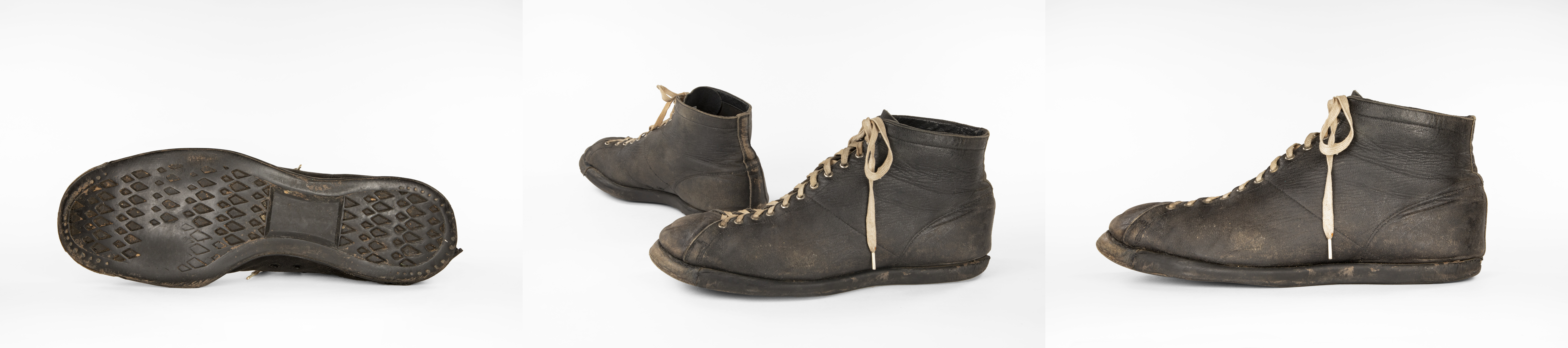
A pair of black leather high top athletic shoes, c. 1920s, photographed in three ways to capture all of their characteristics.

In my last blog installment, I announced the 2022 Digital Photography Project that is run with the assistance of the Government of Canada’s Young Canada Works in Heritage Organizations employment program. Since that blog was posted, we have been busy capturing images of artefacts in the collection. In this blog and upcoming blogs, I will go over some of the details involved in taking the actual picture, processing the image files, and getting the images saved safely to the right place.

The preparation to photograph starts with selecting the artefacts in the storage area. Having been trained in the principles of safe artefact handling, the project team’s artefact handler Catharine Solomon gathers a trolley. She has selected objects that are going into the new exhibition All Dolled Up: Fashioning Cultural Expectations. A few of the items in that exhibition haven’t yet been photographed, and this needs to be done before they are installed as we will need documentation photos for reference while the exhibition is up. So Catharine pulls the catalogue datasheets for the objects flagged for photography (note the orange tags), and collects the artefacts from the storage area, placing them on the trolley. The photography room is just down the hall, and there she has a workspace set up with space to prepare the artefacts. Preparing the artefact most often requires the removal of storage mounts.

With the artefact prepared for photography, she places it on the shooting surface, centering it because the shooting surface and seamless backdrop are quite narrow at only 6 feet wide. Now the image capture begins!

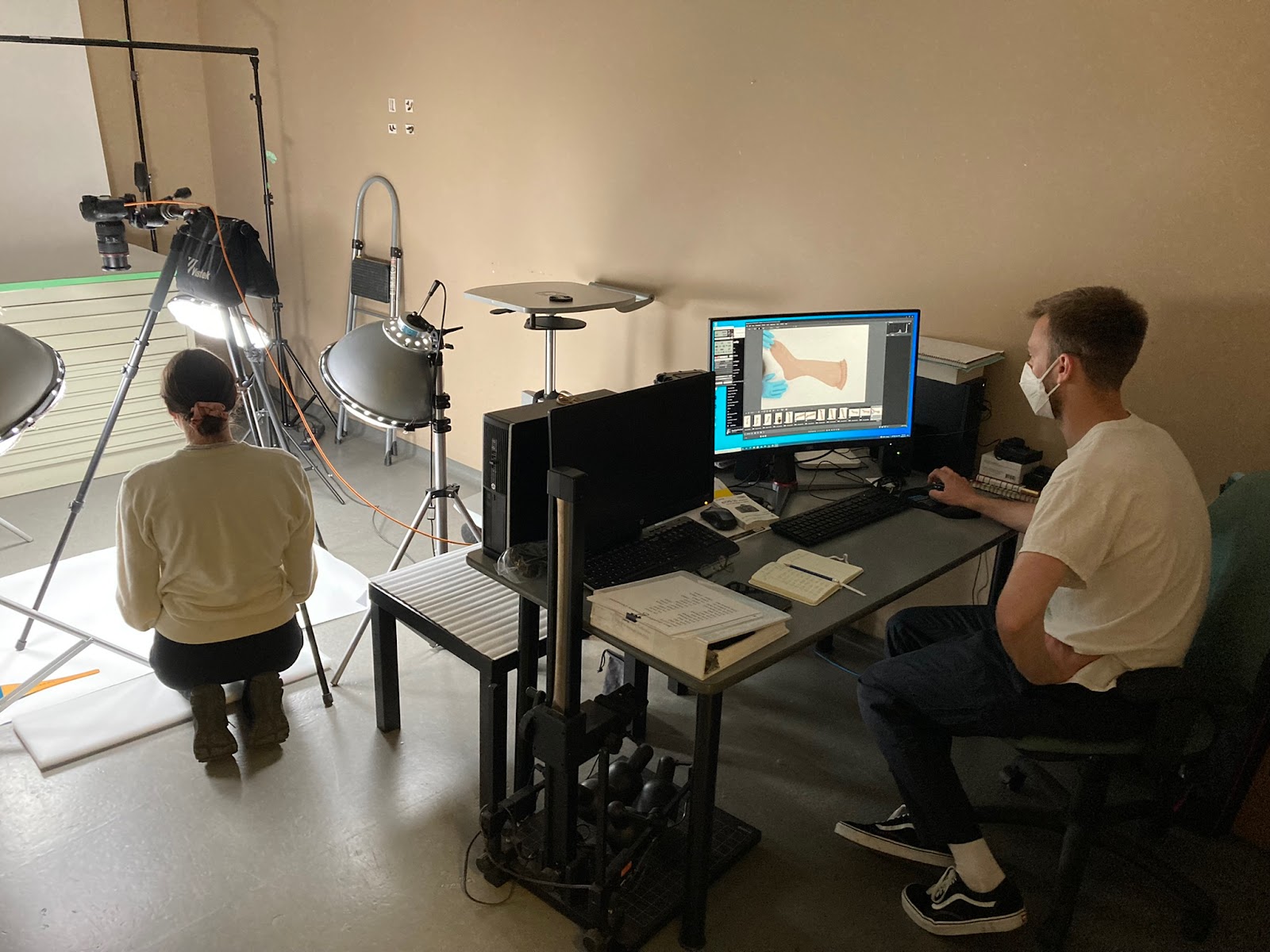
Using a digital single lens reflex (DSLR) camera -- a Canon EOS 5D Mark IV – we capture the images in RAW format, saving each shot to the memory card and to the computer workstation, to which the camera is tethered. Shooting on the Manual setting, and using the 50mm range on the zoom lens, we shoot for maximum depth-of-field keeping the f-stop at f22. The Canon camera has complementary software that allows for remote shooting, so we never have to touch the camera and risk ‘shake’ of the image. The camera also allows for Live View shooting that gives a preview of what the camera is seeing. This large preview displays on the computer workstation. This feature gives the three of us the ability to see what is being captured while we remain a safe 2-metres apart for COVID-19 safety.
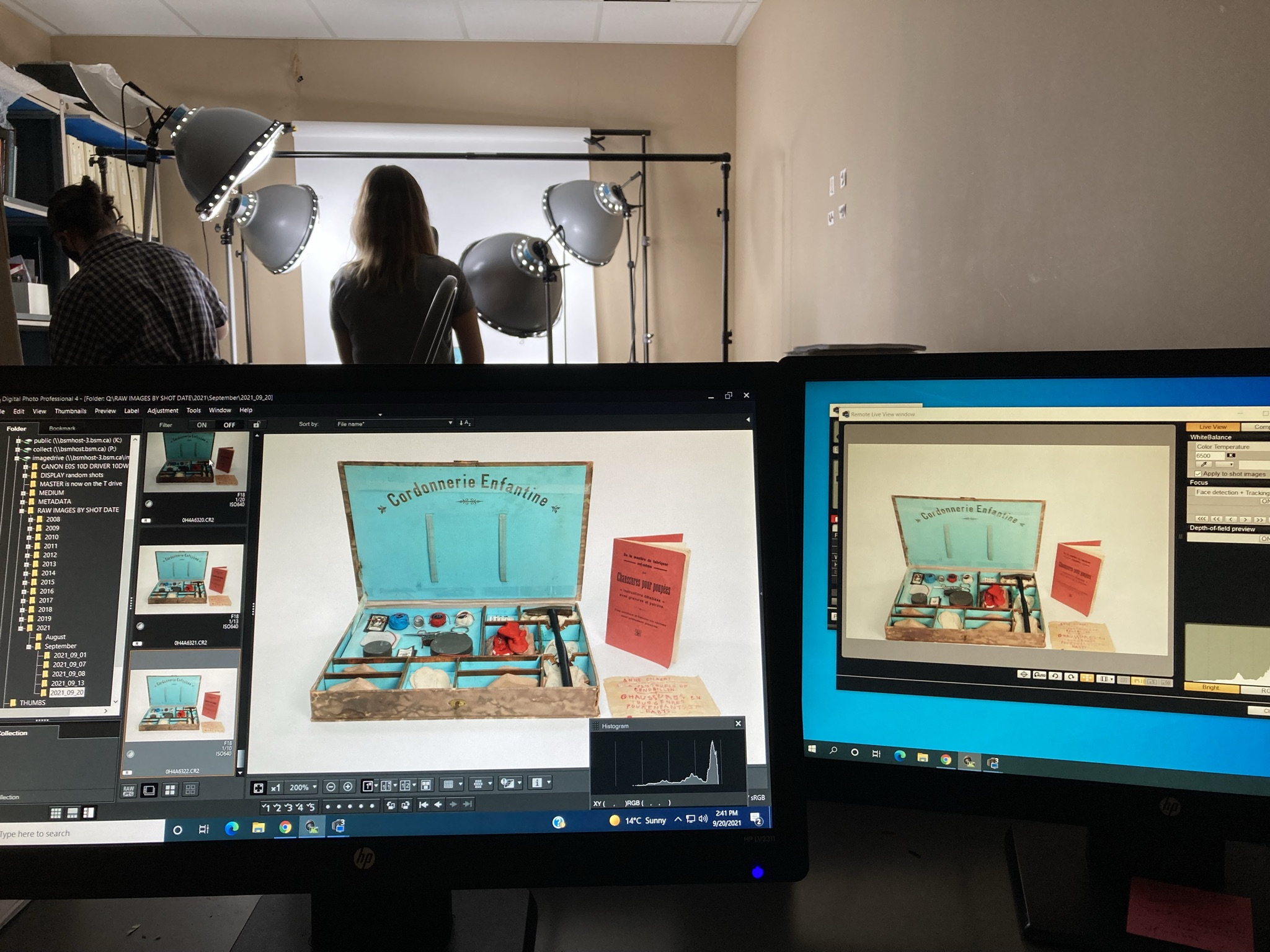
The remote shooting program open on the left screen, and the Live View shooting program in operation on the right screen.

Our lighting setup is simple. We have four 18” lamp heads on tripod stands. Each lamp has a nylon diffuser on its face. The lamps are fitted with cool compact bulbs, a necessity in our very small, not-well ventilated photography room. We arrange the lighting so that two lamps illuminate the backdrop and two lamps illuminate the artefact.

As Christine Spenuk, project photographer, checks for lighting, exposure, focus and composition issues, she captures a few test shots of the artefact. Getting all of the settings perfect for each shot takes time and attention. Both Catharine and Christine check for the quality of the image and even lighting. They keep a logbook of the artefacts they have shot that includes a list of the shots per artefact, the composition of each shot, and the file name of the best shot. This logbook will help with the later steps in processing. The catalogue datasheet that stays with the artefact is also updated with a penciled notation of the date it was photographed.

The final step is to check the composition to see if the shot is showing the most important characteristics of the artefact. Depending on the artefact, curators and researchers may want to see a specific aspect of the shoe emphasized in the shot, perhaps the heel, the closure mechanism, the toe shape, the silhouette or the vamp. Finding a composition and shooting angle that best represents the shoe in an overall shot is sometimes very challenging. This is where creativity comes into play.

After capturing the overall shot, we take at least two additional shots: a profile and a sole shot. So often the sole of the shoe is not seen, and the sole can give a good deal of information, so this in an important shot. If there are finer details on the shoe that should be captured, we will do additional shots. For very close detail shots, we change the lens on the camera to a 100mm macro lens and shoot with an f-stop of f/32, for the best depth-of-field.

After all of the angles have been shot, the artefact is ready to be prepped to go back into storage. The storage mounts that were initially removed are put back into place, and the artefact is placed on the trolley for the short trip back to the storage room.

In the next blog, I will talk about the image file processing that comes next in the process.

This project has been made possible in part by the Government of Canada’s Young Canada Works in Heritage Organizations employment program.

Suzanne Petersen, Collections Manager
  • 0 Comments

This summer I am joined by Emma Pakstas and Eric Watters, both graduate students in Toronto Metropolitan University’s Photography Preservation and Collections Management program at the Creative School. Their work with me on the Digital Photography Project here at the Bata Shoe Museum is funded in part by the Young Canada Works in Heritage Organizations program, Government of Canada.


Shooting in high resolution digital format with a Canon E0S 5D Mark IV, the photos produced during the project are publishable quality, allowing the museum to expand its reach to visitors, researchers and online visitors.

After the initial two weeks of intensive training in our photography process and in artefact handling procedures, the three of us have started to work through this summer’s shot list. Starting with a large stockings and sock collection we acquired in 2018, we are now photographing the Museum’s shoe art holdings which includes works by Marion Borgelt, Marilyn Levine, and Victor Guillen, to name a few. After that segment is done, we’ll move on to shoot new acquisitions.

In this video you can see Emma gently moving this pair of black silk stockings into place on the photo backdrop.

Emma Pakstas is trained as the Artefact Handler for the project and is tasked with the safe and proper movement of artefacts. She plans the shot-order and the movement of the artefacts from the storage rooms to the photography studio where she prepares the objects for photography by removing storage mounts. After placing an artefact on the photo backdrop, she works with the Photographer to perfect the composition of the shot, moving the artefact slightly in order to capture its most photographic angle, and it’s most important features.

Eric records the details in the logbook and selects the photo for processing.

Eric Watters is trained as the Artefact Photographer for the project. His work involves lighting, composition, exposure, focus and depth of field. He sets up the photography equipment for each shot and maintains the equipment, making sure he captures each object at its best angle, allowing its most important features to be captured. He also tracks all of the shots in a journal, a helpful reference for the image processing steps that follow.


After the actual shooting is done, the team will process, resize, format and renamed the image files. The metadata for each image is collected in an excel sheet. Finally, the images will be uploaded to the Museum’s collections management database, along with the metadata. The final step for the three of us on the project team is to update the data sheet hard copies for each artefact. These data sheets are kept next to every single object in the artefact storage room, for quick reference. It’s a great system that merges the digital with the analog, making information accessibility very straightforward for the whole curatorial team.


This project has been made possible in part by the Government of Canada’s Young Canada Works in Heritage Organizations employment program.

Suzanne Petersen, Collections Manager

  • 0 Comments
Canada’s champion skater Ralph McCreath in the mid-1940s wearing the newer type of boot and blade. © Canada’s Sports Hall of Fame

We are celebrating the official launch of our new virtual exhibition Boots & Blades: The Story of Canadian Figure Skating at bootsandblades.ca. The exhibition is in French and in English and contains information on the development of the sport from 1600 to 2022. There are over 40 rarely seen videos and more than 350 images, artefacts and audio clips. The site is fully accessible with captioning, transcripts and more.

This blog will focus on some of the research that went into two sections of bootsandblades.ca: “1920-1945 Form Follows Function” and “1945-1965: Age of Internationalism.” Previously, I’ve written about early blade technology and also the origins of maker marks applied on skates. Both of these approaches give clues to when the skate was made. As we move forward in time to the middle of the 20th century, the sport continued to develop. At this time, skaters were doing fancy figures much less, having reduced the practice of tracing figure-8s and other line shapes into the ice. There was still a figure-8 component to the sport (figures), but it accounted for about half of the skill-set required to be a champion. The other half of the assessment was the free skate component. This is where changes in the sport were dramatic! The sport was getting more athletic and there were changes to the technique of figure skating.

So, how could a skater improve their performance in the free skate category? Adapting the skates to their needs was one way. Technology of materials and improvements in design are two areas in which we see skates improve at this time.

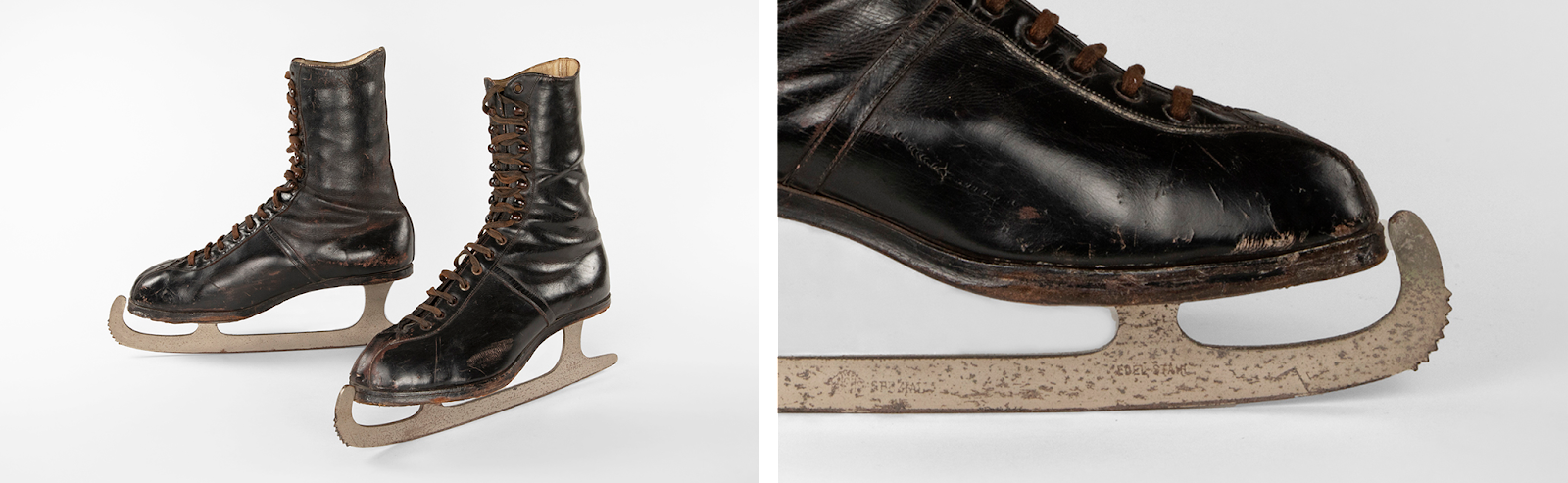
Unworn high-end skating boots made by E. Schmacher a.s., St. Moritz, Switzerland, c. 1930 -1938. Note the rounded toe for more toe movement. A view of the bottom shows the markings for blade placement.

Boot design. Boot design was improved by lowering the leg shaft to just below the skater’s calf, allowing for more free knee and ankle movement. The boot also allowed for more room in the toe area and a good fit over the instep provided improved overall support. The 1930s Schmacher boots shown here have all these features. It is interesting to note that boots and blades were still manufactured and sold by separate companies at this time for all levels of customers. High-end boots and blades have continued to be made and purchased separately, and still are to this day, but skates intended for leisure by the general public started to be sold as a ‘kit’ around this time. As the cost of skates came down, more people could buy them. Incidentally, one of the first companies to offer the kit of boots with blades was Spalding in the United States of America.

Blade design. Blades in the early 20th century were supported with only two stanchions. The toe of the blade was not connected and simply curled upwards, artfully. In the 1930s, a third point of connection became popular and it remains on blades today. This third connection is at the toe, as is illustrated by this early pair by CCM. This design improved stability at the front of the blade, making it preferred for the more athletic movements of the new skating style. The toe pick feature would be integrated on this type of blade soon after.

These CCM blades are marked with the Toronto Junction CCM factory location. Canadian, c. 1930-40s.
Note that the blade is connected to the sole mount in three places.

Technology. The new free skate category required skaters to have a good grip of the ice. Sharpening the blades with deeper edges improves grip and control on the ice. The other effect of deeper edges is reduction in speed. The skater has to push ever harder to move when the blade has deep edges. A balance is needed therefore: not too much edge, just enough to grip the ice and enough for the moves performed.

The edges create resistance, and in doing that they slow the speed of the skater. Shallow edges allow the skater stability, speed and smooth motions. Speed skates, for example, have shallow edges. Deeper edges allow for precise moves needed for complex footwork and jumps. The deeper blade sharpening curve is used by free skaters today, allowing the needed control for the athletics. Still, blades that are cut too deep will slow down the skater, cutting too deeply into the ice. A precise balance is needed to achieve the correct blade sharpening to the exact needs of the skater.

Getting the right boots and blades is critical to a skater’s performance. The design and technology of skates is improving and changing all of the time. Beyond skates, the other aspects that will influence a skater’s performance include the quality of the ice surface, training, coaching, practice and artistry to name a few.

Suzanne Petersen, Collections Manager

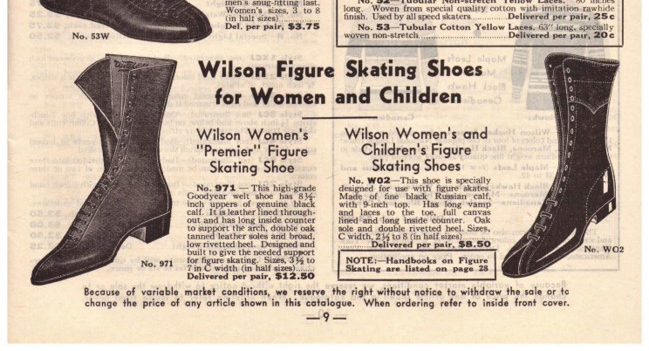
The older boot style with higher leg shaft and narrow, pointed toe influenced by street attire. Wilson Skating Shoes catalogue, 1935-1936. Courtesy Yvonne Butorac
The older blade style with only two stanchions. C.C.M. advertisement in the Toronto Skating Club Carnival Program, 1932. Courtesy Yvonne Butorac
Wearing the older styles of boot and blades, French champions Andrée Joly and Pierre Brunet perform in the late 1920s. Courtesy Canada’s Sports Hall of Fame]
  • 0 Comments
John Wilson’s “The Syers Skate” blade, named after Madge Syers, the first women’s world champion, 1908. Maker of the boots is “The Lobby Shoes” company. Collection of the Bata Shoe Museum. Image © 2022 Bata Shoe Museum.

The skate research for Boots & Blades: The Story of Canadian Figure Skating took me down some fascinating ‘rabbit holes’ of interesting information and histories. In this blog, I will show the details we have found about three pair of skates. These are all from the 20th century.

The first pair here are tan leather boots fitted with blades that curl up in the front. These are constructed differently than the skates we use today. The toe has a ‘pick’, but the metal curl is set forward, so it does not connect with the mount plate of the blade. This would make it more unstable than the skates we have now. This type of toe curl and pick blade was developed in the 1870s, likely by A.G. Spalding & Bros. in the USA. The blades shown here were manufactured by John Wilson, the oldest known blade making company, at their factory in England in Portland Worms, Sheffield. The blades feature John Wilson’s trademark figure of a running greyhound dog on one side, and the model name "The Syers Skate" on the other.

Details of “The Syers Skate” blade. Collection of the Bata Shoe Museum. Image © 2022 Bata Shoe Museum.

Syers is the last name of Florence Madeleine Syers (née Cave) (1881 - 1917), best known as Madge Syers, who was a British figure skater. She is the namesake of this blade model. She is remarkable because she was the first woman to ever compete in figure skating. Before her involvement, women were simply not invited to compete as it was seen as a masculine aspect of the sport. She won the World championships in both 1906 and 1907, and then in 1908 when figure skating was part of the Summer Olympics in London, she won that honour as well. She was 27 years old; the oldest Olympic World figure skating gold medalist even today. Syers, unfortunately, had to retire from figure skating shortly after the 1908 Olympics because of her health. She died of Influenza in 1917, at the young age of 35. Madge Syers was certainly an inspiration to many women in sport at that time. The availability of “The Syers” blade is little known, but this model was most likely created during her peak of influence in the mid to late part of the decade, 1905 to 1910.

Related to “The Syers” skate blade is this pair in the Bata Shoe Museum collection made by A.G. Spalding & Bros. in the USA. Spalding innovated the upturned-toe blade with toe pick feature in the 1870s, which is seen in "The Syers" pair above. They likely produced this “Continental” model for several decades. To narrow down the date range for this pair of skates, we dug further into the name of the boot manufacturer.

Skate blades manufactured by A.G. Spalding & Bros. in the USA, fitted on boots made by the Northern Shoe Company, circa 1906 - 1918. Collection of the Bata Shoe Museum. Image © 2022 Bata Shoe Museum.
Details of the Spalding/Northern pair of skates showing the maker’s marks indicating “Duluth Hockey Shoe” model and the Northern Shoe Company. Collection of the Bata Shoe Museum. Image © 2022 Bata Shoe Museum.

This pair of skates has been dated circa 1906 to 1918 because of the information we found about the boot manufacturer. The boots are the ‘Duluth Hockey Shoe’ model, made by the Northern Shoe Co., in Minnesota. That boot was produced after the Phillip-Bell Shoe company became the Northern Shoe Company in 1906, and a subdivision called Duluth Hockey was created. By 1910, Northern Shoe's four hundred workers produced 1,500 pairs of boots and shoes per day and sold over $1 million of footwear a year. It was a successful company with its own rail line and a dock for loading freighters. In 1918, the owner renamed the business A.J. Hartman Shoe Company.

The curl toe blade was produced in many countries over the period 1870 to 1930. This German-made pair is another example in the Bata Shoe Museum collection.

Skates manufactured by Germany’s Euchs brand showing the toe curl design that extends in front of the skaters boot. “Special” blade model. Collection of the Bata Shoe Museum. Image © 2022 Bata Shoe Museum.

Suzanne Petersen, Collections Manager

  • 0 Comments

The launch of our next virtual exhibition, Boots & Blades: The Story of Canadian Figure Skating, is coming up in the New Year, so the research into skates continues. In this blog, I’ll take a look at a few of the interesting makes and models of blades that we have been learning about.

One of the earliest skates with manufacturer’s marks in the collection are the three pairs shown in this blog post.

The English Club skates with blades rounded up to the foot bed in the front and in the back, are marked “Moulson Brothers Union Works Sheffield”. Knowing the name of the manufacturer allowed us to find out about the company and the dates it was in operation. It was founded in the early 1830s by five brothers and was reportedly bankrupt by 1875. Family descendants formed Moulson Bros & Co. at some point in the 1870s. For this pair of skates, knowing the date range of the company also helped us estimate a date of production for the skates.

Skates manufactured by the Moulson Brothers in Sheffield, England. Collection of the Bata Shoe Museum. Image © 2021 Bata Shoe Museum.

A similar pair of strap-on skates are the Club skates marked “H. Boker”. The blade silhouette on this pair shows a more developed design in the heel profile. We estimate this pair to have been made between the years 1837 and 1870. The company, H. Boker and Co., was founded in 1837 by Hermann Boker in New York City, which was a hardware manufacturing firm affiliated with his brother Heinrich who had his own company in Germany, called H. R. Boker. As an aside, it is interesting to note that the youngest Boker brother founded a branch of the company in Canada at about the same time. The Boker companies specialized in the manufacture of sabers, knives, tools and cutlery, a specialization in to which skate blades fits quite well.

The brand mark of the company is known as the ‘tree’ logo, which was introduced in 1870. As the ‘tree’ mark is not on the blades we have in the collection, we know they were manufactured prior to 1870. The research has aided us in narrowing down the possible date of manufacture to be between 1837 and 1870.

Skates manufactured by H. Boker of New York. Collection of the Bata Shoe Museum. Image © 2021 Bata Shoe Museum.

The final pair of club skates have a metal pressure clamp system instead of the leather strap and buckle attachment that most of the skates up to this date have. The leather strap system was hard to tighten and so the skater’s boots and the attached blades were often not moving in unison. That made it hard to skate. The metal pressure clamp system on this pair are likely an innovation that sought to solve the problem. Manufactured by “Hill, Late Coleman” at “4 Haymarket London”, we can verify that these are English in origin and the history of the company shows it existed from about 1855 until the early 20th century. They were knife and blade makers, who also sold outdoor equipment at that address, including compasses, barb wire nippers and folding axes. The company was run by the original owner without his son from 1855 to 1870, and at that point the company name changed to ‘Hill & Son’.

Skates manufactured by ‘Hill, Late Coleman’ at ‘4 Haymarket London’. Collection of the Bata Shoe Museum. Image © 2021 Bata Shoe Museum.

This history informs us that this pair of skates were manufactured between 1855 and 1870.

Suzanne Petersen, Collections Manager

  • 0 Comments
This is a pair of ‘gliders’. Note the flat metal gliding surface and the thickness of the blade. The blade is also mounted close to the foot and this ‘foot stack’ is made of a thick piece of wood. Collection of the Bata Shoe Museum. Image © 2021 Bata Shoe Museum.


As we continue to do research on the skate collection at the Bata Shoe Museum in preparation for the upcoming online exhibition Boots & Blades: The Story of Canadian Figure Skating, we are looking at the blades specifically right now. As the blades are what touch the ice, they are a major component in the art of figure skating, allowing the skater to glide and move in the desired ways.

The skate artefacts in the collection have blades of so many variations. The length varies, as does the curve of the gliding surface an the way the blade is secured to the foot. There are materials of many types: a variety of types of wood and metal. The blades themselves are made of metal generally.

One of the blade features that we are looking at is the cutting surface – the bottom of the blade where the blade connects with the ice surface. Not much is written about this aspect, but it is a vital feature that can allow gliding if the blade is flat, speed if the blade is honed to a slight arc, and precision if the blade is honed to a deeper arc. The deeper arc creates the two edges that figure skating is done on. The two edges are: the inside and the outside edges. Without these two edges, the skater has no purchase, no control, on the ice surface. Skates without edges are called ‘gliders’; literally, these skates allow you to glide on the ice and were most often used with poles, much like ski poles, to help stabilize the skater.

This pair of ‘gliders’ shows more development with the curled prow or curl at the elongated toe of the blade. Note also that blade surface is completely flat. There are no edges sharpened into these blades. Collection of the Bata Shoe Museum. Image © 2021 Bata Shoe Museum.

The introduction of edges came later, but exactly when, and in which regions it came to first, is difficult to determine. Not much is written about this technical aspect of skate blades. The development of sharpening the edges into the blade surface began in the 19th century, but little else is know. The proof that we see in the artefacts in the collection is the proof of how skating developed.

These three photographs are all the same pair of skates. They are an early pair of handmade skates, likely from the middle of the 19th century. Note the blade has a curled prow and that the blade stops under the wearer‘s foot. The shot of the bottom of the skate reveals the two edges that have been honed into the blade surface. Collection of the Bata Shoe Museum. Image © 2021 Bata Shoe Museum.

The edges create resistance, and in doing that they slow the speed of the skater, but they allow the skater to ‘cut’ into the ice instead of slipping. Shallow edges allow the skater stability, speed and smooth motions. Speed skates, for example, have shallow edges. Deeper edges allow for precise moves including making tracings of curves and circles in the ice. Deeper edges are what figures skaters need.

Suzanne Petersen, Collections Manager

A beautiful pair of skates with heart-shapes punched out of the blades, you can clearly see the ‘u’ shaped edges honed into the bottom surface of the blade in the second photo. Image © 2021 Bata Shoe Museum.
Skates for children, this pair dates to the early part of the 20th century. The metal used for the blade here can hold a more accurate sharpening of edges on the bottom of the blade, as seen in the second photograph. Image © 2021 Bata Shoe Museum.
  • 0 Comments

The Bata Shoe Museum’s long-term project to digitally photograph everything in the collection is moving ahead in 2021. Heading the project since 2007, I am so pleased to have two university students join the museum this summer/fall for a 385-hour Young Canada Works in Heritage Organizations program, funded in part by the Government of Canada.


Catharine Solomon and Christine Spenuk are now working with me to photograph a segment of the collection in high-resolution digital format. After two weeks of specialized training on-the-job, the team will soon be ready to create photographs of almost 900 artefacts, a process that involves many steps, exacting attention to detail, metadata collection and teamwork. The entire process is written up in the 50 page Image Procedure Manual I have written, so there is a written guide as well.

Catharine Solomon is being trained as the artefact handler for the project and is tasked with the safe and proper movement of artefacts. She plans the shot order and the movement of the artefacts from the storage rooms to the photography studio where she prepares the objects for photography by removing storage mounts. After placing an artefact on the photo backdrop, she works with the photographer to perfect the composition of the shot, moving the artefact slightly in order to capture its most photographic angle, and it’s most important features.

Christine Spenuk is the photographer on the project. She is bringing her passion for photography and her image software skills to the work. For the project, Christine is being trained in the photography requirements for this project, which include issues such as lighting, composition, exposure, and depth of field. She will set up the photography equipment for each shot and maintain the equipment, making sure she captures each object at its best light and angle, allowing its most important features to be captured. She will also track all of the shots we take in a journal, which will be updated with every capture.

After the actual shooting is done, the team will process, resize, format and rename the image files. The metadata will be collected in an excel sheet which takes an exacting effort to get all of the details absolutely correct. The images will then be uploaded to the museum’s collections management database, along with the excel sheet metadata.

When the upload is complete, the new photographs are available to staff and researchers for use on our social media, website, publications and more. The final step for the three of us on the project team is to update the data sheet hard copies for each artefact. These data sheets are kept next to every single object in the artefact storage room, for quick reference. It’s a great system that merges the digital with the analog, making information accessibility very straightforward for the whole curatorial team.


This project has been made possible in part by the Government of Canada’s Young Canada Works in Heritage Organizations employment program.


Suzanne Petersen, Collections Manager

  • 0 Comments
The pair of retro adidas Superstars in original packaging, as customized for the BSM by their original designer, Chris Severn. Photo © Bata Shoe Museum.

The Bata Shoe Museum recently received a donation by the pioneer of the adidas Superstar, Chris Severn!

The Superstar was developed by Chris, Horst Dassler and a team of people at adidas after Chris realized the basketball shoe needed improvements. After some prototypes and releases of similar shoes in the 1950s and 1960s, the Superstar was launched in 1969 with some important features, making it one of the most worn shoes in basketball during that decade.

Image of Chris Severn, Horst Dassler and the Superstar.

The Superstar introduced features that no other basketball shoe had. First, it featured a high-cut heel counter to better support the wearer against sprained ankles and rubbing around the heel to prevent blisters.

The higher, more supportive heel counter was an important new safety feature. Photo © Bata Shoe Museum.

Second, the shoe introduced a padded tongue that distributed the pressure of the laces. The tongue allowed the shoe to be laced-up securely without reducing blood circulation to the foot.

Note the padded tongue of the Superstar. Photo © Bata Shoe Museum.

And third, a slightly raised heel, created by inserting a low wedge, gave more cushioning when the player landed after jump shots.

The materials were changed to increase length of wear and serviceability. The uppers were made of leather instead of canvas. The soles featured a new herringbone grip pattern and were made out of a rubber material that gave more traction.

The construction of the sole was improved by adding the iconic line of stitching at the top of the moulded rubber sole. The sole was now both glued and stitched, reducing the chance that the layers of the sole would come apart.

The leather uppers increased wear. The stitched-down moulded sole improved the reliability and longevity of the sole. Photo © Bata Shoe Museum.

The ‘shell’ toe was the last feature to be added. The rubber toe cap protects the wearer and can withstand heavy use during the game. If you have any questions about this new acquisition, let us know.

Suzanne Petersen, Collections Manager

  • 0 Comments

The Bata Shoe Museum (BSM) often lends artefacts to other museums for their exhibitions. Recently, one of our borrowers had such a successful exhibition that the exhibition went on tour, and our artefacts went along for the ride. They are currently on view at the McCord Museum in Montreal until September 26, 2021.

The BSM shoes on loan to the Dior: 1947 to 1957 exhibition are on view now at the McCord Museum until September 26, 2021. © Marilyn Aitken – Musée McCord Museum

The BSM has a wonderful collection of Dior footwear. The collection includes pieces from the earliest years of the label right up to the 21st century. So, when the Royal Ontario Museum (ROM) started to put together the exhibition Dior: 1947 to 1957, curator Dr. Alexandra Palmer inquired about what we might have from that particular date range.

This elegant pump, circa 1954, would have been considered dinner attire due to the styling and the height of the heel—9cm tall. © Bata Shoe Museum

The Dior exhibition looks at the creations made by the House of Dior from its first ten years as a couture house. The ROM has a large collection of garments, but not much in the way of footwear, and so that is where the BSM’s participation became important. A meeting at the Bata Shoe Museum gave Palmer an opportunity to see our footwear artefacts in person. After the meeting, she made an initial selection. Then, after additional research into each shoe by Palmer and her team, she made the final selection. In the end, six artefacts were chosen to be part of the ROM’s exhibition.

Another shot of the the Dior: 1947 to 1957 exhibition, currently on view at the McCord Museum. © Laura Dumitriu – Musée McCord Museum]

Dior: 1947 to 1957 was on view at the ROM from November 2017 to April 2018; it had such high visitation that the ROM decided to offer it as a travelling exhibition to other museums. There was much interest and the final schedule of institutions included: the Glenbow Museum (Calgary), the China National Silk Museum (Hangzhou), and the McCord Museum (Montreal). Here are a few photos from the installation at the Glenbow in Calgary.

A shot taken during the exhibition installation at the Glenbow Museum in Calgary. All but the black pumps are on loan from the Bata Shoe Museum. © Chris Paulocik, ROM
A visitor to the Dior exhibition at the Glenbow Museum, February 3 - June 2, 2019. The pumps in this display are on loan from the BSM collection. Photo by Elyse Bouvier

The pair of pumps below with the aqua and white plaid silk uppers were created for Dior’s Liberté line in 1957. Dior Archives in Paris has identified the fabric as being from Staron, one of the top textile manufacturers in France. The dress in the sketch was made with the same fabric, and also called Opérette.

This pair, named Opérette and dated to 1957, has a subtle check pattern woven into the silk fabric. © Bata Shoe Museum; installation image courtesy of Robinsramblings.ca

The exhibition had quite a few changes made to it for its installation at the China National Silk Museum in Hangzhou. Notably, the text was translated. Here is an example of the signage that advertised the exhibition:

A new graphic design was used in Hangzhou, but the artefacts and photography remained the same.

Last, I leave you with a view of the heels. These are the six artefacts in the exhibition now on view at the McCord Museum until September 26, 2021.

The higher the heel, the later in the day the shoe would have been worn. © Bata Shoe Museum

Suzanne Petersen, Collections Manager

  • 0 Comments
Older Posts Home

About Us

Discover the treasures of North America's charming and surprising shoe museum.

Follow Us

  • twitter
  • facebook
  • Instagram
  • youtube
  • LinkedIn
  • e-news

recent posts

instagram

COPYRIGHT © 2020 Bata Shoe Museum, Toronto, Canada. All rights reserved.
Powered by Blogger.

Template Created By : ThemeXpose . All Rights Reserved.

Back to top