
Plastics Blog - Chapter 4 - Who Are You? Plastics Identification
Guest Post 2012 By Samantha Conover
Different plastics degrade according to their own particular weaknesses. Some plastics are more vulnerable to light, while others are more vulnerable to moisture. All plastics will eventually degrade, but there are particular plastics that are considered “malignant” or “bad neighbours” because their degradation can actually harm nearby materials. In order to best prevent plastic deterioration, it’s necessary to know what kind of plastics you’re dealing with.
Plastics can be identified in many ways. The simplest method of identification involves physical cues and knowledge of production dates. For example, rubber tends to have a characteristic smell. Phenol formaldehyde (the plastic used to make the ever-collectible Bakelite)feels heavier and “chunkier” than other plastics. A plastic object that is known to be from the late 19th Century is more likely to be cellulose nitrate than polystyrene because of known production dates (cellulose nitrate started being produced in the 1860s, while polystyrene entered production in the 1930s). The careful observation of physical and historical cues is often all that is needed to successfully identify a plastic.
 |
| This stylish bathing shoe from the 1920s can be identified as rubber because of its flexibility, characteristic smell and production date. |
Plastics can be more precisely identified through the use of chemical tests. Different tests are used to produce a reaction with a characteristic component of a particular plastic. This reaction usually is visible in the form of a colour change. For example, the test for cellulose nitrate produces a bright blue colour if the result is positive. While these tests offer more accuracy, they require the removal and destruction of a small sample. Scientists have worked to “miniaturize” these tests so that only a very small sample is needed for the reaction to be visible.
 |
Photo of cellulose nitrate test - This bright blue colour indicates that the sample is cellulose nitrate
|
The most exact method of identifying plastics is through chemical analysis which allows a researcher to obtain the fullest knowledge of a sample’s chemical composition. One popular method of analysis is Fourier Transform Infra-Red Spectroscopy (FTIR). FTIR provides information on a material’s molecular structure and chemical bonds. This is done by measuring a sample’s absorption of infra-red light which is mathematically calculated to produce a graph called a spectrum. An FTIR machine works by beaming a ray of infra-red light at the sample. When the molecules in the sample are exposed to infra-red light they vibrate in a characteristic manner. These vibrations are plotted out on the graph which creates a specific pattern. By comparing this pattern to a reference collection of patterns, a researcher can identify the sample. A fun way to understand this is to imagine that each type of plastic scanned has dance “fingerprint” made up of individual dance moves that distinguishes it from others.
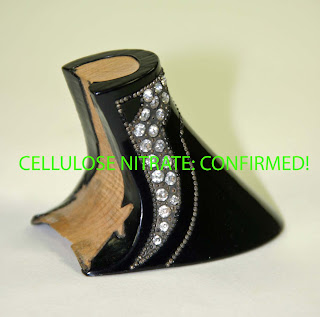
And now… the answer to some of the plastic mysteries I discussed in a previous blog post. It seems my suspicions were right about the shiny lacquer heels! Tests for cellulose nitrate came out positive. Because cellulose nitrate is potentially dangerous to the collection I am advising that heels of this type should be frequently monitored for any changes. I was wrong about the corrosive beads on the beautiful silk shoe. The beads tested negative for cellulose nitrate, but I’m still unclear on their identity. I suppose it’s good to have a mystery to keep me musing.

It has been an amazing experience working with my favourite material at the Bata Shoe Museum. I love plastic because of its ability to provoke controversy and inability to stay static. To some plastic represents cheap and mass-market manufacture. To others it signifies bold modern design. Plastic seems to languish in landfills while revealing its capacity to disintegrate in museum and gallery storage rooms. It can be a crystal clear acrylic rhinestone heel or flexible faux leather boot. I hope that my blogs have inspired some to look at plastics in a new way that finds appreciation for an often overlooked wonder of the modern world!


1 comments
This comment has been removed by the author.
ReplyDelete